Why can an SMS marked “delivered” by the sending platform never actually show up on the recipient’s screen? The question comes up once a campaign wraps, with no clicks and no replies. The answer rarely lies in the message itself: between the aggregator that sends it and the phone that displays it, a mobile carrier’s network sits in the middle, routing the message, sometimes filtering it, without always returning a complete acknowledgment. A growth team can watch its SMS deliverability drop 30% in three months without touching a single line of content. The cause then lies on the delivery side, upstream of the message copy itself.
The delivery chain, from aggregator to handset
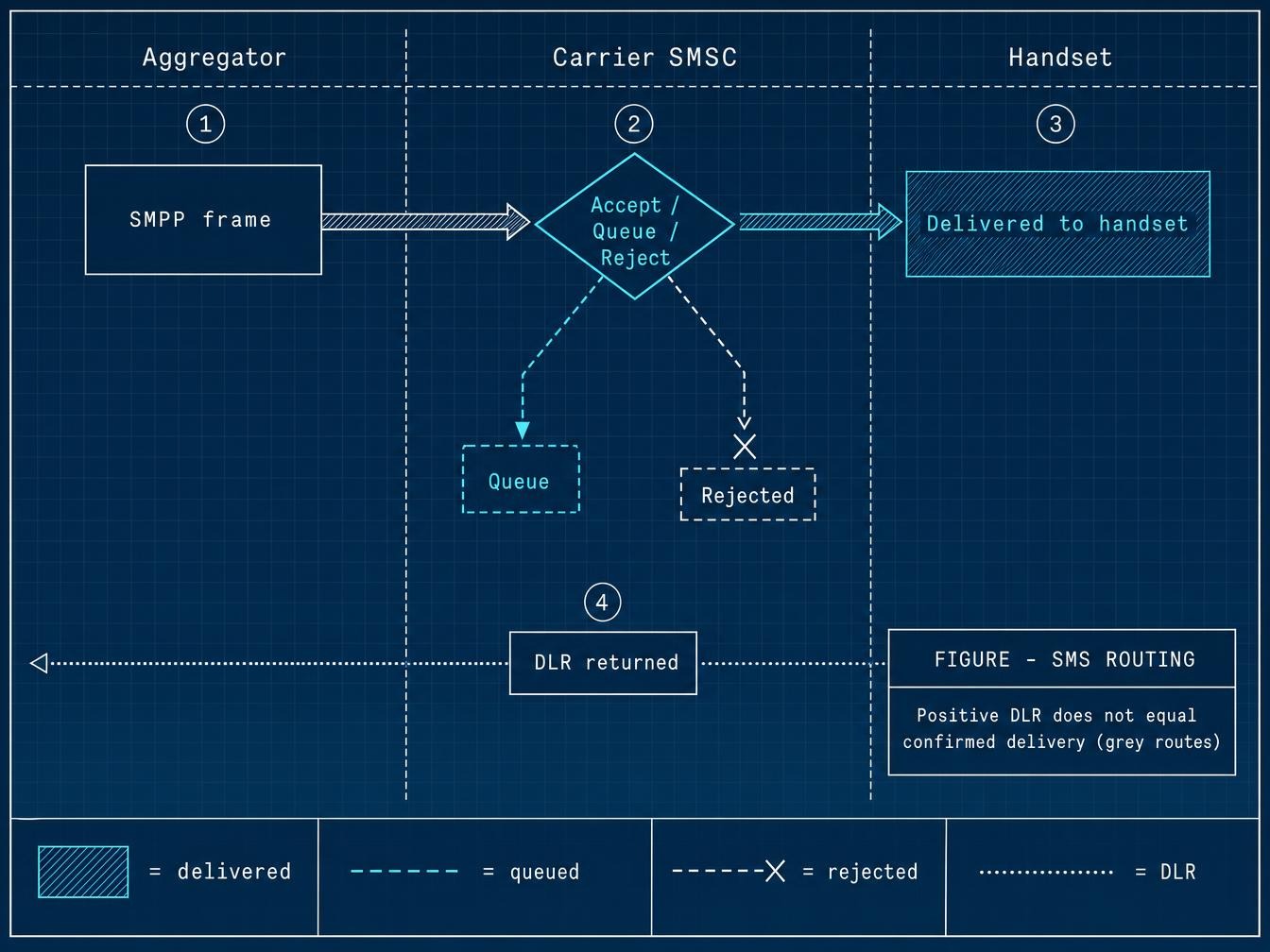
A marketing SMS passes through three links before reaching a screen. The aggregator first receives the request from the sending platform and converts it into an SMPP frame (the standard protocol for exchanges between mobile messaging servers) addressed to the recipient’s carrier. The carrier then routes the message through its SMSC (SMS Center), which decides whether to accept it, queue it, or reject it based on internal rules that are rarely published. The handset finally receives the frame and displays it on screen, provided network coverage holds at that moment and no app-level block is in place on the phone.
Compliant consent collected upfront through a proper SMS opt-in message and adherence to the STOP SMS framework determine access to the network. Neither guarantees anything once the message is handed off to the aggregator. A perfectly legal send can still get filtered at the SMSC level without any notification ever reaching the sender.
What carriers actually filter
UK networks blocked an average of around 50 million scam messages a month between January and March 2025, and mobile customers forwarded 90 million reports to 7726 over the eleven months to March 2025, according to Ofcom. That level of scrutiny falls on every A2P sender, not only the fraudulent ones, and it tightens further on sends that travel through gray routes: transit channels not under contract with the recipient’s network but used to cut sending costs.
Five triggers come up most often in blocking cases observed on the aggregator side:
- Content flagged as suspicious: urgent phrasing, financial promises, vocabulary associated with smishing.
- Abnormal volume or velocity, such as a sudden spike in sends to a large number of numbers within minutes.
- An unregistered sender, or one whose identity doesn’t match the type of message sent.
- A shortened link pointing to a little-known or unauthenticated domain.
- A volume of complaints or unsubscribes that erodes the sender’s reputation over the course of campaigns.
Each trigger works on its own. Combined, they’re enough to tip a normally tolerated sender into systematic filtering, sometimes for several weeks at a stretch.
Sent, delivered, read: what these three statuses tell you (and what they don’t)
Each status tells a different story about a campaign’s fate. “Sent” only means the aggregator forwarded the request to the carrier. “Delivered” means the carrier confirms it delivered the frame to the handset, which is what the DLR captures: the delivery receipt sent by the network back to the aggregator. Nothing in that status says whether the user opened the message. Standard SMS has no native read receipt, unlike RCS, a newer rich messaging protocol that includes one.
That gap affects how campaigns get managed. A growth team basing its decisions solely on the DLR believes it’s measuring engagement when it’s actually measuring network delivery. In practice, click-through rate remains the only reliable read indicator for a non-enriched SMS.
The DLR: a delivery receipt to read with caution
The DLR usually comes back within seconds. On some gray routes, it can also come back positive even when the message never reached the handset: the intermediary carrier sends an optimistic receipt so it doesn’t have to bill the failure to its own partner. The DLR confirms network delivery. Beyond that confirmation, no signal indicates whether the phone actually displayed the message. The user may have read it, or the message may have stayed stuck in the buffer of a handset that was off during the send.
Short code, long number, sender ID: what Ofcom allows
The choice of sender format directly affects how a network handles the message. Three formats coexist in the UK, each with its own rules and its own exposure to filtering.
| Format | Primary use | Regulatory constraint |
|---|---|---|
| Short code (5 digits) | High-volume campaigns, keyword-driven two-way flows | Allocated by Ofcom to mobile providers, then sub-allocated to aggregators, STOP handled natively by the network |
| Virtual mobile number (07 range) | Two-way exchanges through a professional technical platform | Standard mobile numbering, with no dedicated business range, replies route back to the platform |
| Alphanumeric sender ID (11 characters maximum) | One-way transactional and marketing notifications | No statutory register, voluntary registration through the MEF SMS SenderID Protection Registry, and the primary target of network anti-smishing checks |
An alphanumeric sender ID cannot receive a reply, which rules it out for any two-way flow and forces the STOP mechanism into the message body. Registration remains voluntary: Ofcom examined a central registry that would have required every alphanumeric sender ID to be verified before use, then chose to leave the MEF scheme as an industry initiative brands pay to join. Several networks block unregistered headers anyway, so skipping registration produces much the same outcome as a ban.
In its statement Combatting mobile messaging scams, published on 15 July 2026, Ofcom set out rules requiring mobile providers to block numbers, links and sender IDs linked to scam messages, to run Know Your Customer checks on new business senders, and to cap sending volumes on pay-as-you-go SIMs. The measures covering person-to-person messaging take effect on 18 January 2027, those covering application-to-person messaging on 15 July 2027.
What actually tanks a delivery rate
Network blocklisting remains the heaviest-hitting cause. A sender reported repeatedly through 7726, the free shortcode UK networks use to collect spam reports, sees its sends filtered almost systematically for several weeks. Content filtered at the SMSC level comes next in frequency, ahead of invalid or inactive numbers, poor sender reputation built up across multiple campaigns, and an unregistered sender ID.
Invalid numbers carry more weight than most people assume. A ported or never-assigned number triggers an immediate rejection, as does a number canceled since the list’s last sync. A number that’s technically valid but unreachable (a phone off for months, or a deactivated SIM card) eats up a send credit without ever returning a clear error to the aggregator. Checking a number’s validity and activity before sending, through an HLR lookup that queries a carrier’s subscriber registry in real time, remains one of the only ways to rule out this factor before it drags down sender reputation.
Adding a check before every campaign can feel like one more tool in an already crowded stack. But if the aggregator doesn’t flag unreachable numbers, no other link in the chain will do it instead.
RCS is starting to change the equation
RCS reached 70% penetration of the UK mobile base in 2026, with traffic up 174% year over year (Infobip, Messaging Trends Report 2026). Worldwide, business RCS traffic is on track to pass 200 billion messages by 2027, against 70 billion in 2025 (Juniper Research). The protocol natively includes read receipts, verified brand identity, and a channel less subject to standard SMS anti-spam filtering. The shift remains partial, limited to compatible handsets and to campaigns built for this channel: a delivery mechanism still distinct from that of standard SMS.