
A lead that answers yes to all 4 letters of BANT can still never sign. The Authority criterion assumes one identifiable decision-maker, yet a B2B purchase often runs through several approvers. The BANT method stays useful if you treat it as a first-call filter, with the right questions and a scoring grid.
What the BANT method is
The BANT method is a B2B lead qualification framework that scores a prospect on 4 criteria: Budget, Authority (the decision-maker), Need and Timeline.
The method is said to have started at IBM, where it helped decide whether a prospect deserved a salesperson’s time. Today it is used when an SDR (sales development representative) turns an MQL (a lead marketing considers ready) into an SQL (a lead sales has accepted) and then into a meeting for an account executive. A qualified lead ticks both need and buying capacity, whereas a bad lead rarely ticks both.
Questions to ask for each BANT criterion
Start with the need: “What keeps you from reaching your goal today?” Each criterion is then validated with 3 or 4 open questions, worded differently so the call does not feel like an interrogation. Every criterion has a green light and a red flag. A Gartner survey published in March 2026 among 646 buyers found that 67% of them would rather skip the salesperson for at least part of their purchase. Every question you ask has to give them something back.
Budget
This criterion measures the ability to pay, not the exact amount. Green light: a budget line exists, or the prospect knows who releases it. Red flag: “we’ll look at budget later” with nobody to rule on it.
- How much has the team spent on this topic over the last 12 months?
- Is the topic in the 2027 budget, or will it need a decision?
- What does this problem cost you today in hours per week or in lost revenue?
- Above what amount does signing move up a level?
Authority
The goal is to map the whole decision, with every approver on it. Green light: the contact describes the approval circuit and agrees to bring the decision-maker into the conversation. Red flag: they answer “I don’t know” when asked who signs and refuse to widen the discussion.
- Who else will see the proposal before signature?
- What was your last purchase of this kind in 2025 or 2026, and who approved it?
- Which departments (procurement, IT) weigh in on the choice?
- Can we invite them to the next call?
Need
A need is proven by a cost or a pain the prospect describes in their own words. Green light: a quantified problem and a metric to move. Red flag: casual curiosity (“it’s for market research”) with no consequence if nothing changes.
- What happens to the business in 6 months if nothing changes?
- What are you using today, and what bothers you about it?
- Who feels the problem day to day?
- Which metric has to move for the project to count as a success?
Timeline
The deadline has to be tied to a real event. Green light: a date linked to an expiring contract or a launch. Red flag: a vague deadline (“before the end of the year”) with no consequence if it slips.
- What event sets the go-live date?
- Which steps come before signature?
- What happens to the project if it slips by 3 months?
A complete BANT qualification grid
The table gives one question per criterion, with the answer that validates and the answer that disqualifies. Copy it as is into your qualification sheet.
| Criterion | Question | Answer that validates | Answer that disqualifies |
|---|---|---|---|
| Budget | Is the topic in this year’s budget? | Yes, with an amount in euros or a named owner | No, and nobody to rule on it |
| Authority | Who signs, and through which circuit? | A described circuit, decision-maker reachable | “I don’t know” and a refusal to widen the call |
| Need | What pain does this problem cause today? | A quantified loss or a described blocker | “Nothing in particular” |
| Timeline | What event sets the date? | Contract ending on December 31 or a dated launch | “Later this year,” with no dated event |
Fictional scoring example. An 80-person company confirms a quantified need: 12 hours a week lost to manual data entry. It announces a €6,000 envelope and aims for September 2027 to go live. The managing director, however, has not been met: 3 criteria out of 4. You do not reject the lead. You book a second meeting with the managing director before sending a quote.
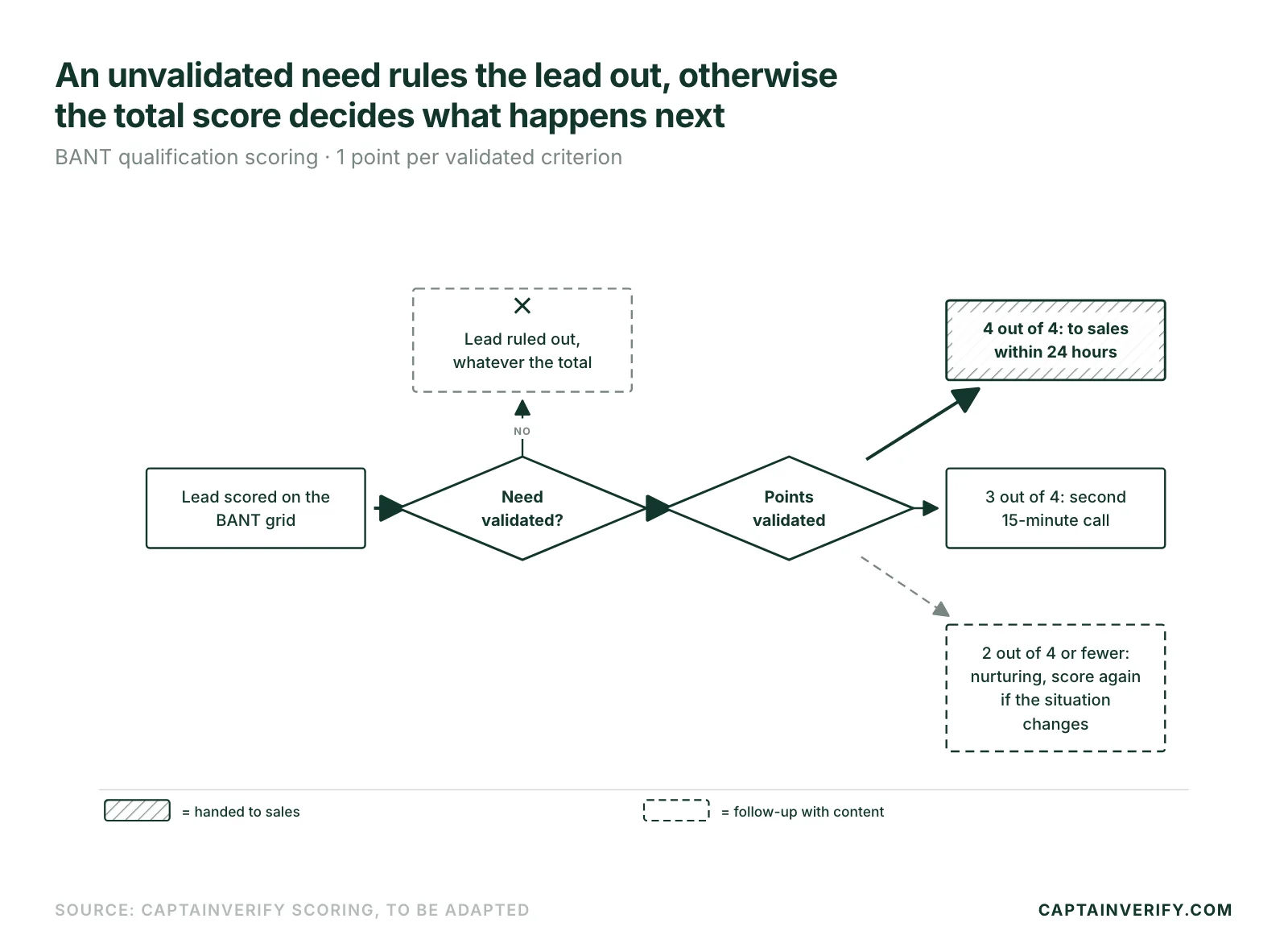
A scale to adapt to your offer: 1 point per validated criterion, 0 points for a fuzzy one. A need that is not validated rules the lead out whatever its total.
- 4 out of 4: the lead goes to sales within 24 hours.
- 3 out of 4: a second 15-minute call closes the missing criterion.
- 2 out of 4 or fewer: the lead goes back to nurturing, gets follow-up content and is scored again when its situation changes.
The limits of the BANT method
BANT is seller-centric: it checks whether the prospect fits the salesperson, not whether the prospect’s problem hurts enough to justify a project. It leaves 4 blind spots.
- Collective decisions. The contact you talk to often has no signing power. The buying committee of a large account spans several departments.
- Budget raised too early. Asking for an envelope in the first minutes of the call scares off a prospect who has not yet put a number on the problem.
- Long cycles. A budget missing in January can be voted in Q3.
- Company size. In a small business the owner signs alone. A large account needs a full approval circuit.
The Gartner survey published in May 2025, run among 632 B2B buyers, puts buying groups at 5 to 16 people spread over at most 4 functions. It finds that 74% of these teams experience “unhealthy conflict” during the decision. Teams that reach consensus are 2.5 times more likely to report a high-quality sale.
The fix is in the order of the questions: need first, money last. The questionnaire follows this sequence:
- Need: get the prospect to describe the problem and its cost.
- Timeline: tie the problem to a dated event.
- Authority: map the approvers once the need is established.
- Budget: only raise the amount at this stage.
BANT, MEDDIC, SPIN Selling or CHAMP: which one to choose?
BANT works as a quick filter at the SDR stage. Once the sale gets complex, a finer method takes over. Several decision-makers and a long cycle are reasons to switch.
| Method | What it assesses | Stage | Best for |
|---|---|---|---|
| BANT | Budget, Authority, Need, Timeline | First call, SDR | Short sales, small businesses, quick triage of an inbound lead |
| CHAMP | Challenges, Authority, Money, Prioritization | First call | BANT turned around: the problem comes before the money |
| MEDDIC | Metrics, Economic buyer, Decision criteria, Decision process, Identify pain, Champion | Open opportunity | Complex sale with a buying committee |
| SPIN Selling | Situation, Problem, Implication, Need-payoff | Discovery and pitch | Getting the prospect to measure the cost of their problem |
SPIN Selling comes from Neil Rackham’s book (Huthwaite), published in 1988 by McGraw-Hill, which draws on an analysis of 35,000 sales calls. It does not qualify a lead: it structures the discovery conversation. It therefore combines with BANT without replacing it.
MEDDIC was born at PTC, a CAD software publisher, in 1996, written by Dick Dunkel and Jack Napoli and led by John McMahon. It adds the internal champion, the person who defends your offer in meetings when you are not there. It also adds an economic buyer who is distinct from your contact.
A simple rule: BANT decides whether a lead deserves your time, MEDDIC decides whether an open opportunity will sign, and SPIN runs the conversation in between. CHAMP fits when the prospect cannot yet put a number on their budget.
Where to record the answers and how to fill in the qualification sheet
Record the 4 answers in dedicated fields of a business CRM, as 4 checkboxes (Budget, Authority, Need, Timeline). Lead scoring adds up the points according to the scale above. The conversion rate of 4-point leads, compared with that of 3-point leads, tells you whether to tighten or loosen the threshold.
An empty job title field makes it impossible to judge Authority before the call: B2B data enrichment fills it in, along with company size. For a lead that comes in through a form, the job title only gives a presumption about Authority. The first call validates the need and the deadline, then the approval circuit, then the budget. For an outbound lead from cold prospecting, the need has not been declared yet: ask the Need question first and score only what the prospect said themselves.
Verify email addresses before applying the grid
A lead whose address bounces cannot be qualified: a filled-in grid is worthless if the first email never arrives. Run the list through an email verification tool before the first sequence: a hard bounce gets fixed before sending, not after the email provider complains. A catch-all address is spotted before it is scored as reachable. Contacts with wrong or outdated details also skew Authority and Timeline, so remove bad leads before scoring.
Add a 5th box to the qualification sheet, “address verified”: a lead scored 4 out of 4 whose address is not valid stays on hold until another contact channel (phone, LinkedIn) is confirmed. The salesperson then does not lose the 24-hour slot on an unreachable contact.
Take 10 recent leads from your CRM, run them through the grid above and list those that land on 2 criteria or fewer: they go into nurturing before any new call.