


You chose your email service because it was the one at the office. Or because the IT Director decided it ten years ago. But have you considered the real cost of a poor choice?
According to MailReach (2025), Outlook shows an inbox placement rate of 75.6%. Gmail reaches 87.2%. For every campaign sent to Outlook mailboxes, one in four emails disappears before it is even read. The problem isn’t your content. It’s the plumbing.
This article doesn’t list features. It shows which providers dominate the market, which companies use them, and how this choice concretely impacts your deliverability.
Gmail and Google Workspace: the choice of startups and modern enterprises
Google Workspace holds 50.34% of the enterprise productivity tools market, used by over 6 million websites in the U.S. according to ElectroIQ (2025). The dominant provider by far.
Companies on Google Workspace are mostly startups, agencies, SMBs with a strong digital culture. Airbus has moved onto it. Spotify, Uber, Twitter (now X) too. In France, many scale-ups and mid-caps have followed in the last five years.
The main reason: native integration with Drive, Meet, and Docs reduces the number of tools to manage. Deployment is quick, with no on-premise infrastructure. And the sender reputation of Google servers remains strong, which supports email deliverability.
Gmail represents about 48.5% of all global mailboxes. If you are doing B2B emailing, most of your recipients are on Gmail. Knowing Google’s filtering rules is not optional.
Microsoft 365 and Outlook: the standard for large organizations
Microsoft 365 remains the benchmark for large enterprises with strong hierarchical structures. Law firms, banks, government agencies, industrial groups are the ones running Outlook. Not because it’s the best tool, but because the Microsoft ecosystem is already in place.
Word, Excel, Teams, SharePoint: everything is interconnected. For an organization of 5,000 employees working in document silos, migration is a project counted in months and millions.
What few marketing teams measure: Outlook’s spam filters are among the most aggressive on the market. In 2024, Microsoft strengthened its AI-based detection models. Result: 75.6% inbox placement where Gmail reaches 87.2%. If your primary target uses Outlook, email address verification and list hygiene become prerequisites. Not options.
Zoho Mail: the email service for SMBs looking to break free from the duopoly
Zoho Mail isn’t a name you hear at major tech conferences. Yet, it’s a consistent alternative for small businesses managing multiple domains without going via Google or Microsoft.
No ads, respects privacy, low pricing. The free plan covers up to five users. The paid plan starts at $1 per user per month. For a team of ten, it’s ten times cheaper than Google Workspace.
Companies on Zoho Mail are often independent firms, service providers, associations. Native multi-domain management is a real advantage in this segment.
The weak point: the reputation of Zoho’s servers is less established. For high-volume marketing sends, watch your bounce rates closely.
ProtonMail, Tuta, Mailfence, Mailbox.org: encrypted emails for regulated sectors
ProtonMail is hosted in Switzerland. Its servers don’t read your emails. End-to-end encryption is enabled by default. The technical architecture guarantees it, not a marketing page.
Tuta (formerly Tutanota) takes the logic even further. Based in Germany, Tuta also encrypts email subjects and contact lists. Its model is entirely open source. NGOs, law firms specializing in digital law, and investigative journalists use it when ProtonMail isn’t enough to reassure their IT Director.
Mailfence is Belgian. Its uniqueness: it combines OpenPGP encryption, digital signatures, and document storage in one interface. Companies adopting it seek a compromise between security and everyday use without friction. It is found in consulting firms, health sector SMEs, and organizations handling sensitive data without wanting to train their teams in PGP.
Mailbox.org is German, hosted on green energy-powered servers. Its positioning targets companies wanting both encryption, strict GDPR compliance, and an integrated office suite (calendar, contacts, cloud storage). German SMEs and local administrations are its primary users.
In France, GDPR pressure has accelerated the adoption of these European email providers. Providers hosted outside the EU expose companies to compliance risks, which legal departments are documenting increasingly seriously.
“Major email services like Gmail and Outlook analyze content to provide targeted ads or feed their AI models, a problematic practice for companies concerned with data privacy.” — Orange Belgium, business blog
FastMail and Mailo: discreet alternatives serving specific niches
FastMail is Australian. No free plan, no ads, no tracking. The service starts at $3 per month and attracts a clientele of developers, technical freelancers, and small agencies wanting fast, clean, distraction-free emails. FastMail supports custom domains and offers integrated calendars and contacts. Its user base remains modest, but its sender reputation is decent for low to medium volumes.
Mailo (formerly NetCourrier) is French. Hosted in France, subject to French law. It is one of the few sovereign email providers offering a free plan with 1 GB of storage. The premium offer rises to €1 per month. Mailo targets individuals, associations, and small entities wanting an alternative to the GAFAM without opting for a Swiss or German provider. Its weak point: almost nonexistent third-party integrations and an interface that shows its age.
Yahoo Mail, AOL, and GMX: a legacy that persists in certain sectors
Yahoo Mail isn’t dead. With 1 TB of free storage and a user base dating back to the 2000s, it remains present in certain sectors: public retail, media, personal users converted into B2C contacts.
AOL Mail follows the same trajectory. Simple interface, unlimited storage, adequate spam filtering. GMX, meanwhile, is the German Yahoo: free, popular in German-speaking Europe, with a loyal but aging user base. GMX belongs to United Internet group and shares its infrastructure with Web.de. If you send campaigns to the DACH market (Germany, Austria, Switzerland), you’ll have GMX addresses in your lists.
No one recommends these tools for a professional team in 2026. But if your client base includes people who have never changed their email address, you’ll have Yahoo, AOL, and GMX boxes in your lists. And that weighs on your deliverability.
Each provider has its filtering algorithms. A Yahoo address does not react like a Gmail address, and GMX filters differently from Outlook. Segmenting your sends by recipient domain is a practice the best email marketing teams have already adopted, especially to manage their complaint rates.
What the choice of provider changes for your deliverability
Most articles on email providers stop at the features. They don’t talk about what happens when your emails arrive in these boxes.
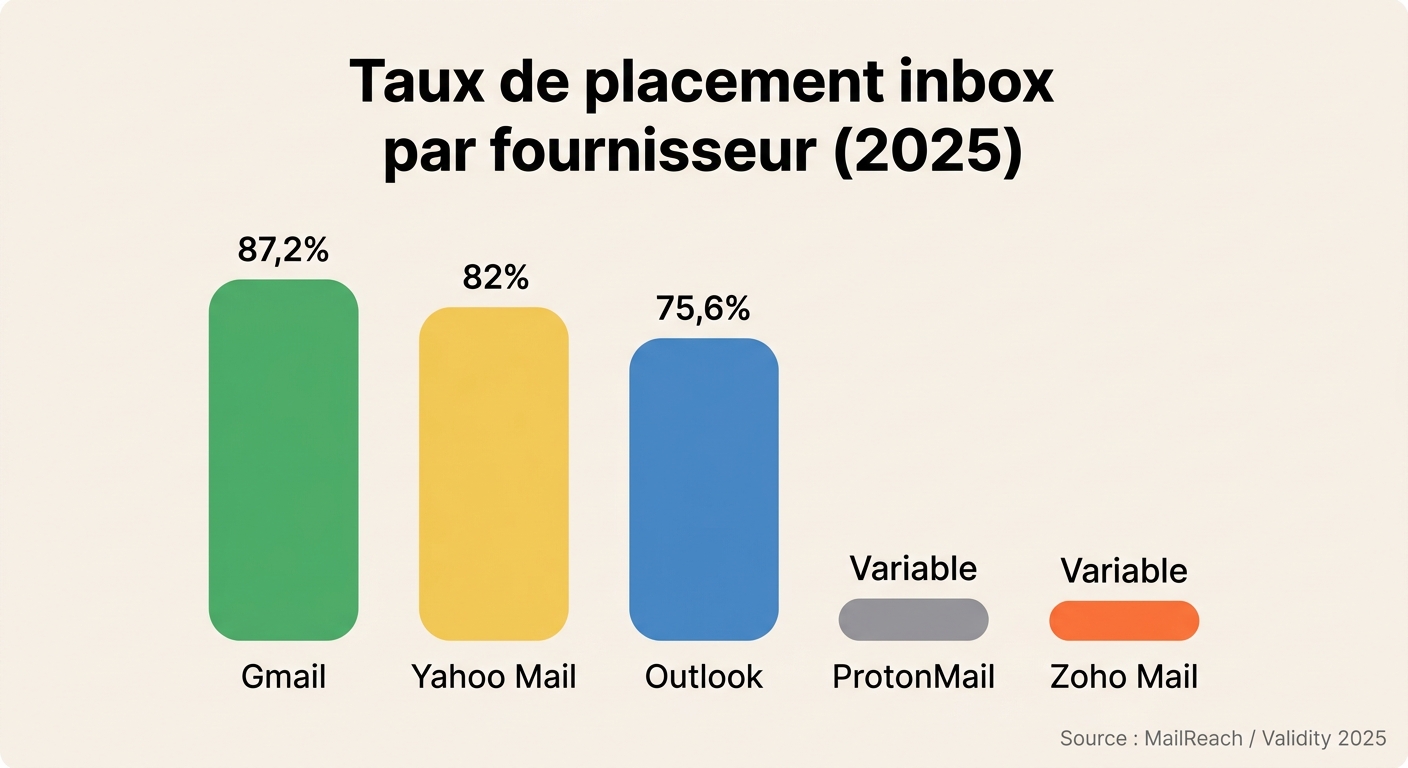
| Provider | Mailbox Market Share | Inbox Placement Rate | User Company Profile |
|---|---|---|---|
| Gmail / Google Workspace | ~48.5% | 87.2% | Startups, SMBs, large tech companies |
| Microsoft 365 / Outlook | ~19.8% | 75.6% | Large conglomerates, banks, governments |
| Yahoo Mail | ~2.5% | ~82% | Public sector, retail, older B2C base |
| ProtonMail | <1% | Variable | Law, health, finance, NGOs |
| Tuta (formerly Tutanota) | <1% | Variable | NGOs, journalism, digital law |
| Mailfence | <1% | Variable | Health SMEs, consulting, sensitive data |
| Mailbox.org | <1% | Variable | German SMEs, local administrations |
| Zoho Mail | <1% | Variable | Multi-domain SMBs, independents |
| FastMail | <1% | Variable | Developers, freelancers, tech agencies |
| Mailo | <1% | Variable | Associations, individuals, FR sovereignty |
| GMX | ~1% | Variable | DACH public, historical European base |
The implication is direct. If your prospect base consists of large French companies (banks, industrials, CAC 40 groups), you’re mostly writing to Outlook boxes. Your real deliverability rate is structurally lower than if your target is startups on Gmail.
The solution is not to change providers. It’s to work on contact list quality and your sender domain reputation.
And if the problem isn’t the provider, but your list?
No matter the recipient’s provider, an unmaintained base sinks everything. A bounce rate over 2% is enough to trigger filters on both Gmail and Outlook. If you send to invalid addresses, your domain’s reputation degrades, no matter your tool. We’ve detailed the mechanism in our article on invalid email addresses and how to avoid them.
Your recipient’s email provider determines if your message arrives. Your list must be clean enough to survive it.