Between 20% and 50% of an email database’s contacts are inactive at any given time. These addresses don’t just weigh down your statistics: they actively harm your sender reputation. Since the Gmail and Yahoo rules that came into effect in 2024 and are still enforced in 2026, sending campaigns to an uncleaned list can lead to a permanent rejection of messages, rather than just landing in spam. The email win-back is the re-engagement sequence targeting these inactive subscribers. Its role has shifted: it’s no longer just a revenue recovery tactic, it’s also what safeguards your sender reputation.
Why inactive customers cost more than you think
A contact who hasn’t opened your emails for 90 days affects your spam complaint rate and reduces your sender score with mail services. Lists with more than 30% inactives generate about €0.08 in revenue per email, compared to €0.27 for lists maintained under 15% inactives, which is a 1 to 3.4 ratio with the same content sent (Validity/ReturnPath).
These rules are still fully active in 2026. Gmail and Yahoo strictly enforce the set thresholds: senders whose spam complaint rate exceeds 0.3% are no longer just sent to junk folders, their messages can be rejected. Leaving inactives without a structured decision (re-engage or remove) is no longer sustainable.
The economic factor is aligned as well. Retaining an existing customer is on average five times cheaper than acquiring a new one. For recently inactive ones, the likelihood of reconquest is around 20% to 40%. This is high compared to the cost of traditional acquisition.
How to structure an effective win-back sequence?
Before launching any re-engagement, run your segment through a mass email verification. Each year, between 20% and 25% of a database’s addresses become unusable. An inactive in your CRM is not necessarily a live address server-side: sending to invalids generates hard bounces that immediately damage your sender reputation.
The most successful re-engagement campaigns follow a progressive escalation logic across 3 to 5 emails. The typical sequence spans 30 to 60 days after inactivity detection, with behavioral triggers rather than fixed dates.
Email 1: Soft Reminder (D+0): A straightforward message focusing on the value of the relationship. No promotional offer. Short subject line, personalized with the first name. The goal is to gauge if there’s any engagement signal left (open, click). Test emotional subject lines (“We haven’t seen you for a while…”) against utility lines (“Is your account still active?”).
Email 2: Targeted Incentive (D+7 to D+14): If email 1 didn’t generate engagement, offer a concrete deal rooted in purchase history: discount on the most purchased category, early access to a new release, free shipping. The incentive should be time-limited (five to seven days) to create urgency without seeming desperate.
Email 3: Last Call (D+21 to D+30): The message “this is your last chance to stay.” Clearly state that the address will be removed from the mailing list if no action is taken. This type of email generates high click rates: the contact didn’t want to leave, they needed a concrete reason to act. It’s also the one that protects deliverability: non-responders are cleanly removed, without generating spam signals.
6 examples of win-back emails that convert (and why)
Theory is helpful. Seeing what brands do who manage their re-engagement well is even more telling. Here are 6 emails collected from different sectors, with what works in each.
Too Good To Go: Raw Emotion
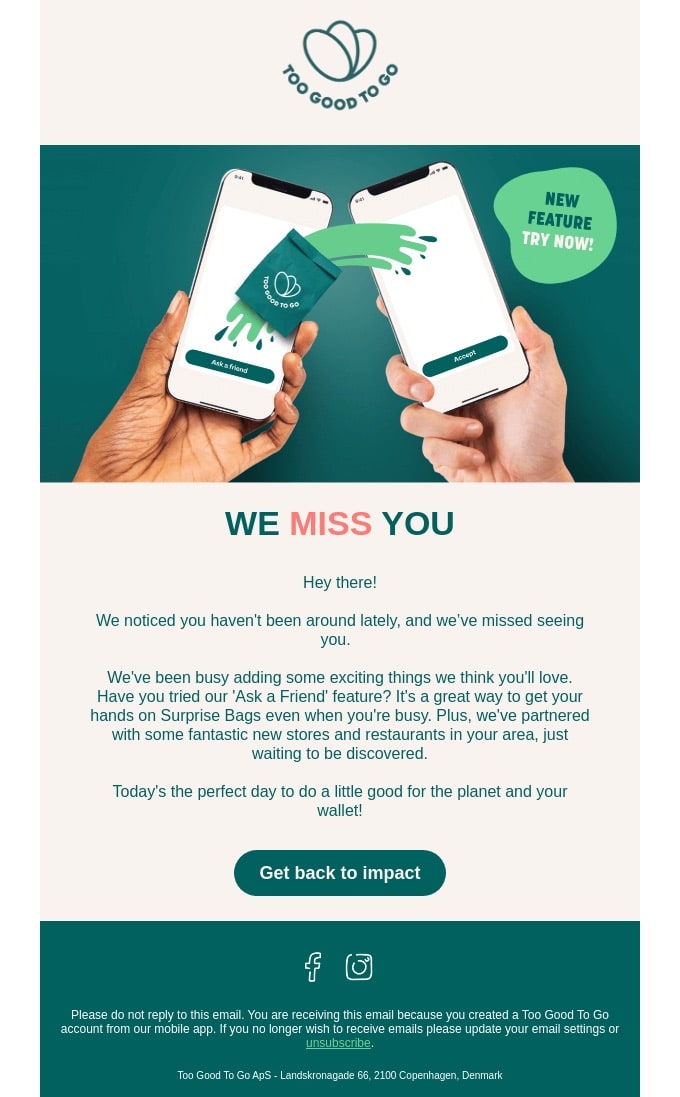
Subject: “WE MISS YOU”. Two words in uppercase, no period. Too Good To Go relies on emotional simplicity: no offer, no incentive, just the relationship. The message body is short. The CTA directly links to available restaurants nearby. This format works when the brand has strong emotional weight and the app usage is part of a daily ritual. For a less affinity-focused brand, the same subject would fall flat.
Tinder: The Lost Visibility Lever
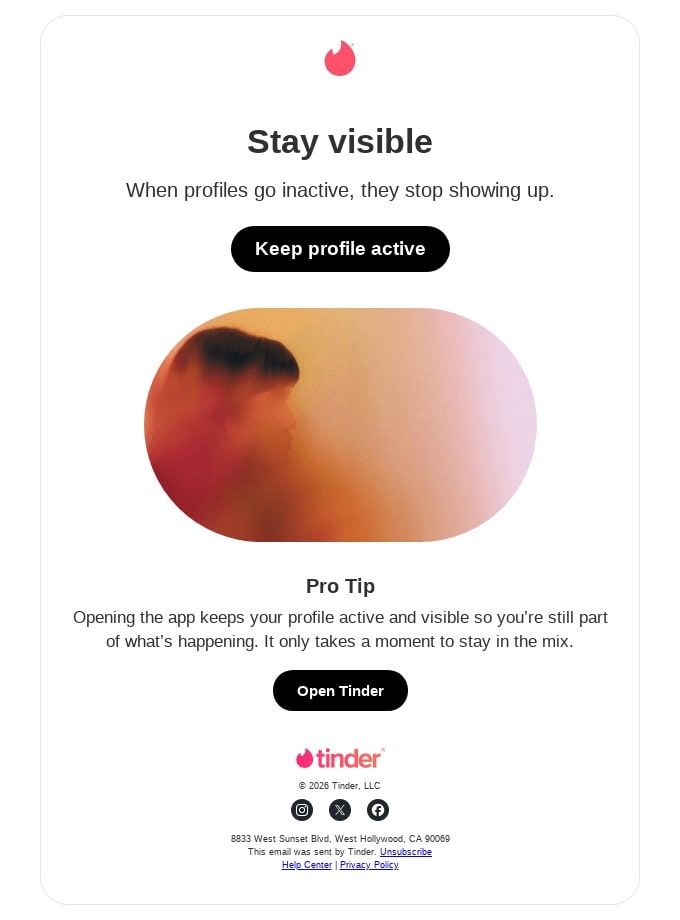
Subject: “Stay visible”. Tinder doesn’t say “come back”. Tinder says: your profile is losing visibility. The framing focuses on the loss, not the benefit. It’s FOMO applied to re-engagement: inaction has a visible and measurable cost. The email doesn’t mention any discount. It purely plays on the algorithm’s mechanics that the user knows. This strategy transfers well in B2B for any product where inactivity has a measurable impact on performance.
Fratelli Burgio: The Survey as Re-engagement Pretext
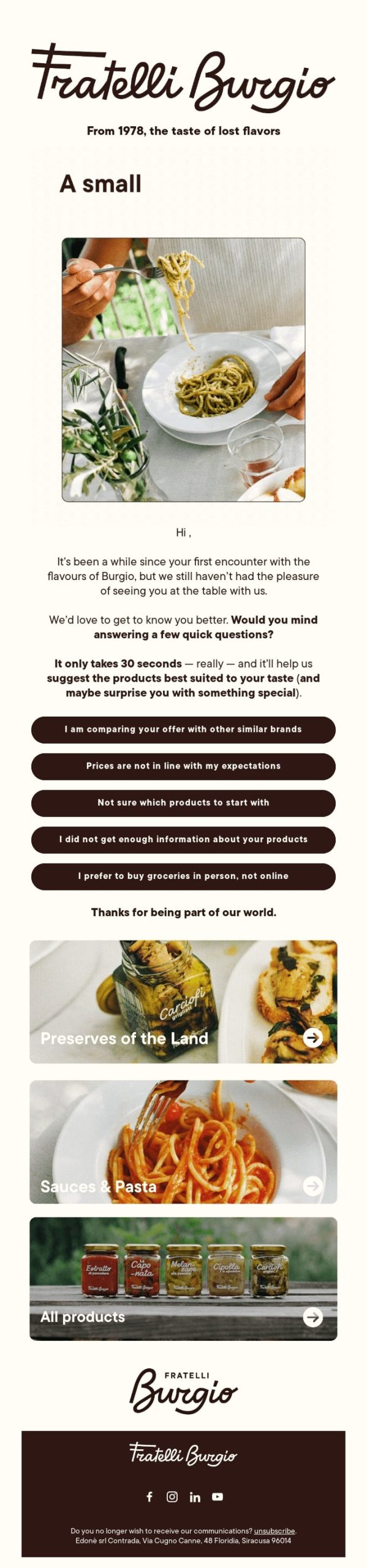
The restaurant Fratelli Burgio sends a satisfaction email to its inactives. No discount, no “we miss you”. A simple question: what happened? This format serves two goals simultaneously. It collects qualitative data on the reasons for leaving and re-engages through implicit flattery: they take the time to ask for the contact’s opinion. The response rate to this type of email often exceeds that of incentives-based follow-ups because the ask is less commercial.
Constant Contact: “Are we a match?”
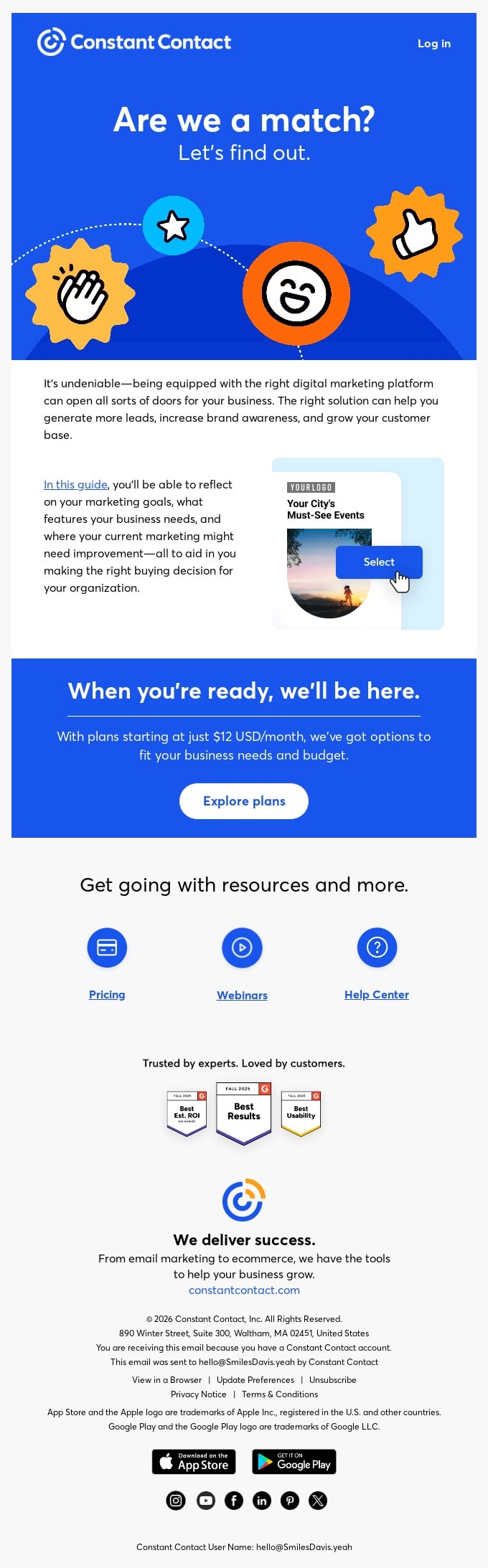
Constant Contact, an email marketing platform, chooses a deliberately quirky tone for a B2B email. The subject “Are we a match?” borrows from dating parlance. The content proposes updating subscription preferences, not directly reactivating a paid account. It’s an intermediate step that reduces friction: the user is not forced to pay, they’re invited to specify what they want to receive. Result: cleaned list and a better-qualified reactivated segment.
Slack: Social Pressure as a Trigger
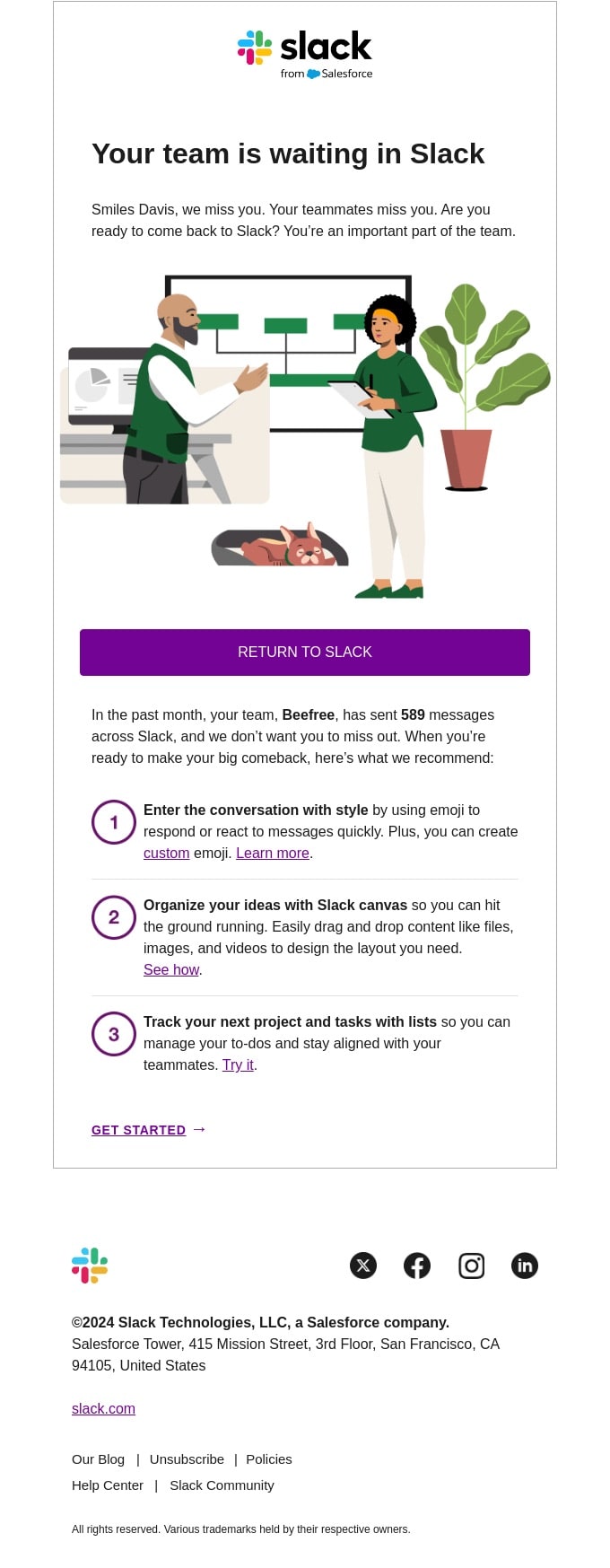
Slack’s subject: “Your team is waiting”. Not “we”, not the Slack team: your team, your colleagues. The lever is not commercial, it’s social. For a collaborative tool, it’s the shortest and most effective argument. This format applies to any product used collectively or where a member’s inactivity impacts a group: HR platforms, project management tools, B2B marketplaces.
Popeyes: Humor as a Differentiator
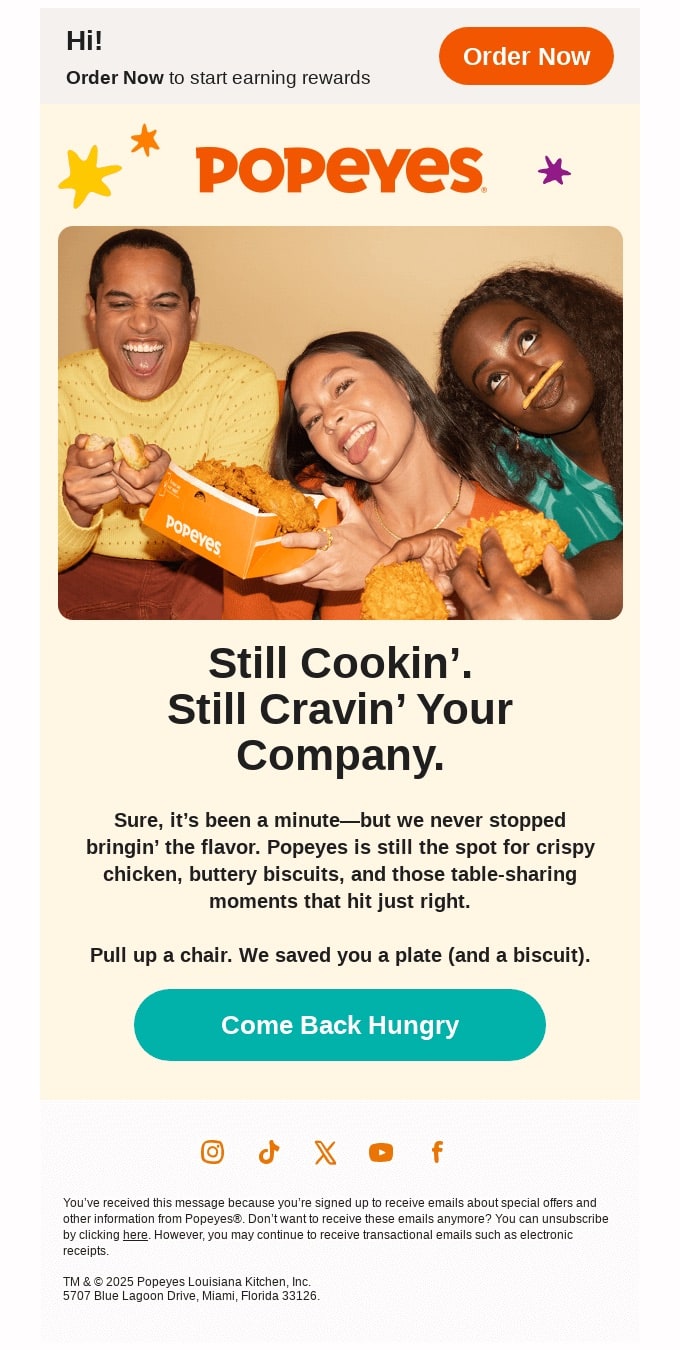
Subject: “Still Cookin'”. Popeyes plays on its signature product (fried chicken) with a pun that fits the chain’s brand voice. There is a concrete offer with an end date, but it’s the tone that makes the difference in an inbox saturated with identical promotional emails. This approach isn’t transferable to every brand, but it illustrates a general principle: matching the usual brand tone with the win-back tone makes the email recognizable without even reading the sender’s name.
Segment to Avoid Re-engaging Everyone the Same Way
Treating “inactives” as a homogeneous segment is the most common mistake. RFM Segmentation (Recency, Frequency, Monetary) reveals very different profiles in this group: a customer who bought eight times in two years then disappeared for four months doesn’t have the same potential value as a subscriber who signed up six months ago without ever converting.
In practice, three profiles emerge:
| Profile | Criteria | Recommended Sequence |
|---|---|---|
| Dormant High-Value Customer | High purchase history, inactive 60-120 days | 3 emails + strong incentive + sales call if B2B |
| Passive Occasional Customer | 1-2 purchases, inactive 90-180 days | 2 emails + limited offer, removal if no response |
| Never-Converted Subscriber | Signed up, no purchases, inactive 60+ days | 1 value email (content, usage), direct removal if no response |
What to do with contacts who don’t respond?
Removing non-responders is the most counterintuitive yet necessary action. A list free of its unrecoverable inactives mechanically improves the open and click rates of subsequent campaigns. It signals to Gmail and Outlook algorithms that your messages interest their recipients. It also reduces the risk of stumbling upon spam traps, which are addresses recycled by providers to identify senders who don’t clean their lists.
According to Validity data, maintaining inactivity rates below 15% allows achieving inbox placement rates above 95%. Beyond 30% inactive contacts, this rate drops to 76%. Removing is not data loss: it’s what ensures your next sends reach the inbox.
“Automations represent 2% of email sends but generate 30% of revenue, with a revenue per send 16 times higher than broadcast campaigns.” (Omnisend, Email Marketing Statistics)
Automated win-back sequences, triggered by specific behavioral criteria rather than static lists, outperform for this reason. An inactive who becomes active again after a well-executed sequence generates more revenue than before their silence. Contacts who return after a win-back sequence often have better engagement rates than recent subscribers. This is no coincidence: they’ve had time to decide if they really wanted to stay.
FAQ
When is the right time to trigger a win-back email?
The optimal window is between 60 and 90 days of inactivity for most e-commerce sectors. For monthly subscription services, 30 days suffice. For seasonal purchases (fashion, travel), waiting 90 to 120 days avoids re-engaging at the wrong point in the purchase cycle.
Should a discount be included in every win-back email?
No. Systematic discounts condition contacts to wait for an offer before reacting, which erodes margins in the long term. The first email should be based on value or curiosity. The incentive comes with the 2nd message, if the first one went unanswered.
How to measure the success of a re-engagement campaign?
Three indicators matter: the reactivation rate (contacts who opened or clicked at least once within 30 days post-sequence), the post-reactivation conversion rate, and the evolution of spam rate and inbox placement rate in subsequent campaigns. This last point is often overlooked: yet, it’s where the real effect of cleaning can be measured.