Segmented SMS automations generate up to 30 times more revenue per recipient than broadcast campaigns, according to Klaviyo 2024 data on over 3 billion analyzed messages. Not because SMS inherently performs better. It’s because the message reaches the right contact, at the right time, with the right content. Without segmentation, sending an SMS is not marketing. It’s noise.
SMS segmentation involves dividing your subscriber list into homogenous groups based on behavior, purchase history, location, or level of engagement, to send messages tailored to each profile. This principle directly influences the profitability of an SMS program.
Why SMS Segmentation Changes Outcomes in Measurable Ways
Sending an untargeted message to 10,000 subscribers results in a predictable outcome: an above-average unsubscribe rate and a conversion rate lower than what the channel can offer. SMS boasts a 98% open rate (EZTexting, 2025). Opening means nothing if the message doesn’t match the recipient’s profile.
The gap between targeted automations and generic sends is documented. Automated flows (abandoned cart, post-purchase sequence, reactivation) generate an average of $3.07 to $10.78 per message (Postscript, 2025). In the automotive sector, this figure reaches $19.14 per message. Broadcast campaigns don’t come close to these levels.
This mechanism has a simple explanation. An SMS automation triggers when the contact’s intent is detectable: they just abandoned their cart, placed an order, or haven’t purchased in 120 days. The context is known. The message can respond directly.
Automated flows generate up to 30 times more revenue per recipient than standard campaigns, precisely because they rely on a behavioral trigger rather than a send schedule.
Klaviyo, SMS Benchmarks by Industry 2024
The Five SMS Segments You Need to Know
Not all segments require the same level of database maturity. Some work from the first month. Others need sufficient history to be reliable.
Behavioral Segmentation: based on recent actions (pages viewed, links clicked, products added to the cart but not bought). This is the highest-intent segment. A contact who has viewed the same product page three times without buying sends a clear signal.
Demographic Segmentation: age, gender, profile attributes collected at opt-in or via CRM. Relevant for brands with distinct catalogs by profile. Less precise than behavioral because it relies on declared data.
Geographic Segmentation: location and time zone. Two direct effects: optimization of send time (9 AM-2 PM and 5 PM-9 PM local time according to industry recommendations) and targeting local events for stores with physical locations.
Purchase History Segmentation: average basket size, purchase frequency, categories bought. Allows identification of VIP customers (generally the 20% generating 80% of revenue) and offers them early access or private deals.
Engagement Segmentation: click-through rate, conversion rate on recent sends. Used for two things: maintaining pressure on active contacts, removing or reactivating dormant contacts before they degrade deliverability.
Getting Started: Three Segments That Are Enough to Begin
Creating twenty segments when launching an SMS program is counterproductive. Contact lists rarely have enough volume for micro-segments to yield interpretable results. Three structuring segments are enough to start.
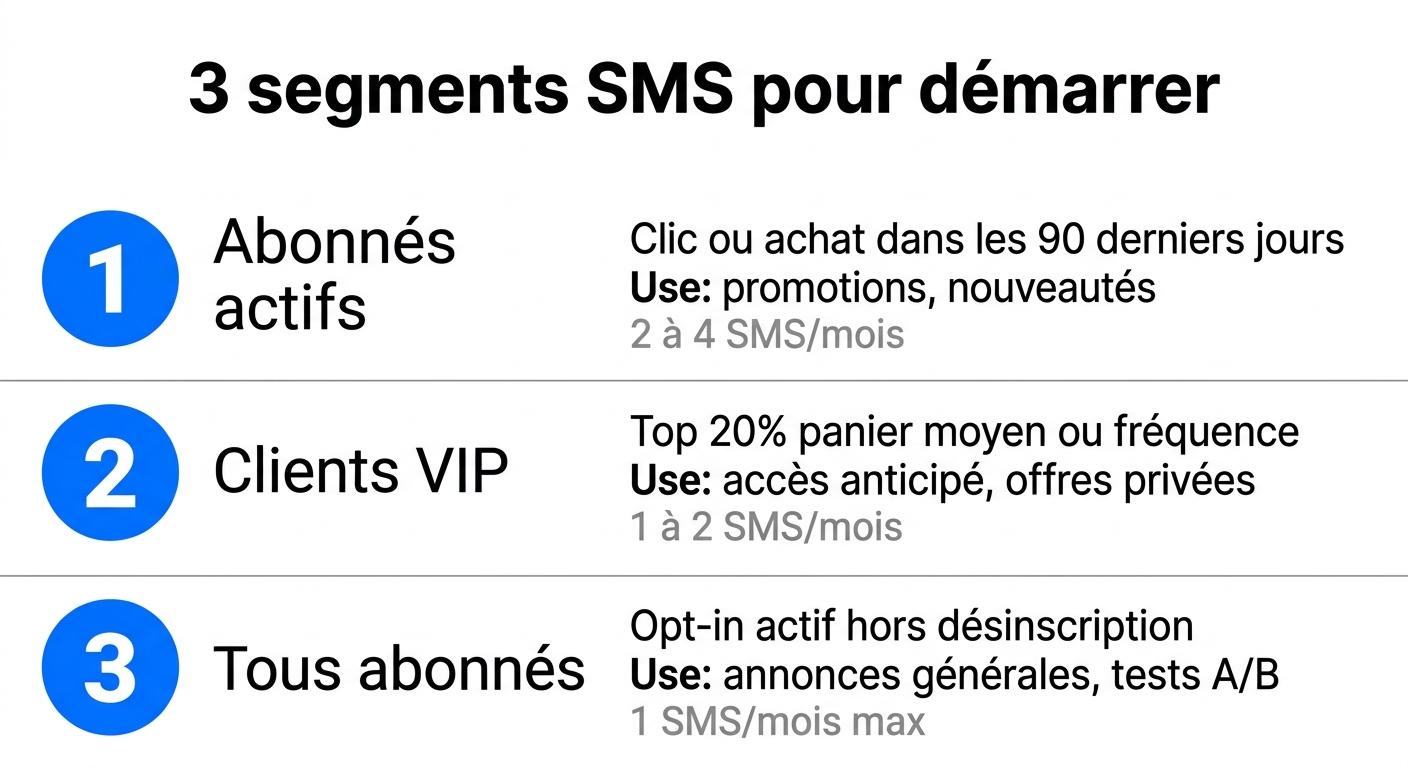
| Segment | Definition Criteria | Primary Use | Recommended Frequency |
|---|---|---|---|
| Active Subscribers | Click or purchase in the last 90 days | Promotions, new arrivals, flash sales | 2 to 4 SMS per month |
| VIP Clients | Average basket size or purchase frequency in the top 20% | Early access, private sales, exclusive offers | 1 to 2 SMS per month |
| All Subscribers | Active opt-in, excluding unsubscribed | General announcements, A/B tests | 1 SMS per month maximum |
This structure avoids two common mistakes. The first: sending the same messages to VIP clients and new subscribers. The second: overloading low-engagement contacts, accelerating unsubscribes.
Segmented Automations: The Sequences That Generate the Most Revenue
Four automations concentrate most of the value generated by SMS marketing segmentation. Their effectiveness relies on a specific trigger, not on an arbitrary schedule.
Welcome Series: three messages sent at 30 minutes, 48 hours, and 7 days after opt-in. The first capitalizes on the contact’s maximum intent. The following two naturally filter those who purchase after the first send: they move to the post-purchase segment and leave the welcome sequence.
Abandoned Cart Recovery: sequence at 1 hour, 24 hours, and 48 hours. The first message recovers abandonments due to technical friction (payment issues, interruption). Deliverability and IP reputation. The third may include a commercial incentive but only for contacts who haven’t purchased since the first send. Offering a discount systematically trains contacts to abandon their cart to wait for the coupon.
Post-Purchase Sequence: thank you at 24 hours, request for review at 4 days, cross-sell at 7 days. The timing of the third message depends on the sector: for a consumable product, it might be advanced to 5 days.
Reactivation: contacts with no interaction for 120 days. A single message with a clear offer. If no response, removal or move to a cold list. Keeping dormant contacts degrades the overall quality of the database and skews engagement metrics.
GDPR Compliance and Opt-In: Non-Negotiable Rules
SMS segmentation assumes a subscriber base built on explicit consent. In Europe, GDPR requires active opt-in (pre-ticked box prohibited) with a clear mention of the purpose of the send. Each message must include a functional opt-out option.
This framework directly shapes segment quality. A list collected through active opt-in shows higher click rates than a list built through pre-ticked boxes, precisely because contacts have shown genuine intent.
The unsubscribe rate is a health indicator of segmentation. Below 3.5%, according to Postscript 2025 benchmarks, the program is within standard. Above, the frequency pressure is too high, or messages don’t match the targeted profiles.
Validation and Updating of Segments
A created segment is not fixed. Behaviors evolve. An active customer can become dormant in three months. A VIP contact might see their average basket fall after a period of intense buying.
Dynamic updating of segments (in real-time according to behavioral events) is the norm on current SMS platforms. It ensures that a contact receives the message that matches their current state, not their profile from six months ago.
Two metrics guide optimization: revenue per message sent (RPM) and net list growth rate—i.e., new opt-ins minus unsubscribes. The first measures targeting effectiveness. The second measures the long-term viability of the program. A program generating a high RPM but losing 5% of its list growth isn’t sustainable over time.
In 2025, 66% of companies are increasing their SMS budgets (SimpleTexting, 2025). Those investing without segmenting are funding sends that their subscribers endure. The question isn’t whether SMS works: the channel works. The question is exactly for whom the message is written.
Frequently Asked Questions About SMS Segmentation
How many segments should you create initially?
Three segments are enough to start: active subscribers (interaction in the last 90 days), VIP clients (top 20% by value), and the entire subscriber base for general announcements. Multiplying segments without having sufficient volume results in groups too small to be interpretable.
What is the recommended send frequency per segment?
Between 2 and 4 SMS per month for active subscribers. 1 to 2 SMS per month for VIPs. The entire list should not receive more than one SMS monthly, excluding major events. Beyond that, the unsubscribe rate increases mechanically.
Does SMS segmentation apply to automations or just campaigns?
To both. Segmented automations (abandoned cart and post-purchase) are the most profitable as they combine behavioral triggers and tailored messages. Broadcast campaigns segmented by profile or engagement ensure different messages are sent to a first-time buyer and a loyal customer of three years.
How do you measure the effectiveness of an SMS segment?
Revenue per message (RPM) is the main indicator. It allows comparing the effectiveness of two segments receiving different messages. Click-through rate and conversion rate complement the analysis, but RPM remains the decision metric for allocating send frequency between segments.